


Ejection plastic mold have two-plate molds, three-plate molds and runnerless molds
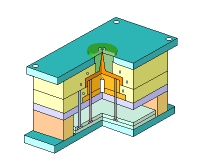 The basic structure of a mold is determined by restrictions such as selections of molding shape, production quantity, molding material, or gate position, as well as productive and technical considerations.
The structure of a mold is categorized into a two-plate (two-structured) mold, a three-plate (three-tructured) mold, a runnerless mold, and a special mold, each of which has special characteristics.
Two-Plate (Two-Structured) mold
A two-plate mold has one parting line (PL: where the mold divides) which separates two parts – fixed side and moving side..
Advantages:
– The structure is simpler than that of three-plate mold or runnerless mold.
– The cost for producing a mold can be reduced.
– The gating method includes side gate, direct gate, or submarine gate, and side gate and direct gate are generally used.
– With submarine gates, you can remove parts and runner (including sprue and gate) separately, making it unnecessary to perform post processing. (you will learn in detail about the process for runner in “Runner System”).
Disadvantages:
– Since side gate and direct gate require processing runners, they are not suitable for automation or energy saving.
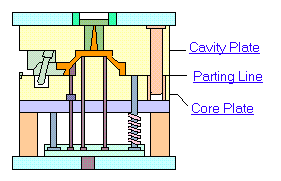

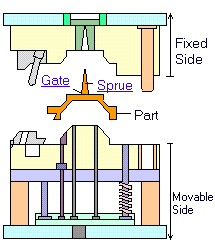
More details:
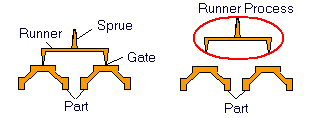
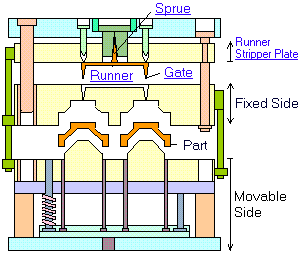
– The correlation of sprue, runner, and gate As shown in the figure below, sprue, runner, and gate are separately labeled. However, the term “Processing runner” includes processing of the sprue and gate. See “Runner System” for details.
– Sprue: The entrance where molten plastics is injected into a mold. Runner: The channel to transfer molten plastics to the part. Gate: The entrance to the part from the runner.
Three-Plate (Three-Structured) Mold
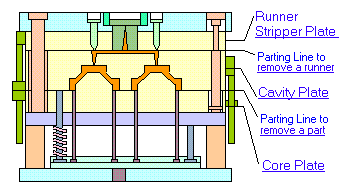
A three-plate mold has two parting lines (PL: where the mold divides) to remove a runner and a part, and is composed of three parts: fixed side, moving side, and runner stripper plate.
Advantages:
As parts and runners can automatically be removed separately, this is suitable for automation and is widely used for mass production.
Disadvantages:
– The structure is more complicated than that of a two-plate mold.
– The cost is also higher.
Runnerless Mold
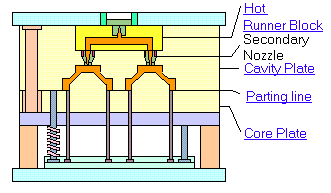
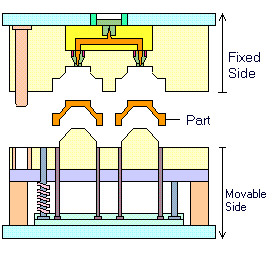
Though the two-plate mold and three-plate mold removes parts and runners, the runnerless mold removes only parts. Although a hot runner mold, an insulated mold, and a well type mold are all included in this type of mold, a runnerless mold generally refers to a hot runner mold.
Advantages:
– Since the runner is not discharged at all, and only the part can be removed, the runner disposal equipment is not necessary.
– The sprue or runner area is always being plasticated by the heater, so molten plastics fills up well.
– As it is suitable for automation, it has many merits for mass production.
Disadvantages:
– The structure is complicated.
– The cost is also quite high.
– Loading materials is time consuming.
Heating Methods of Molding Material
To melt a molding material , plastication is normally done in the injection cylinder. However, the runnerless mold utilizes the hot runner method which melts molding material with a heater.
The hot runner method consists of two types: the internal heating type which heats up material from within the secondary nozzle, and the external heating type which heats up material from outside the secondary nozzle, as shown below
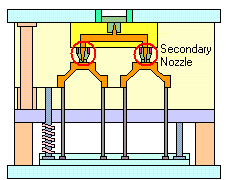
Internal Heating Type
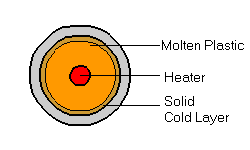
– High in heat efficiency.
– High in circulating resistance.
– Difficult to change color (due to solid cold layer inside)
External Heating Type
Following two types
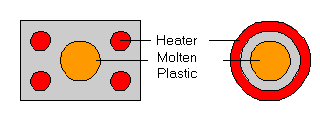
- Low in heat efficiency.
- Low in circulating resistance.
The conditions of material suitable for a hot runner mold are as follows:
Not sensitive to temperature, high in heat stability, and easy to mold at low temperature.
Not sensitive to pressure. Injection molding must be done in low temperature.
High heat deformation temperature for quick removal from a mold.
High heat conductivity.
Low in specific heat.