


In this chapter, you will learn about the functions, characteristics, and shapes of the sprue, runner, and gate.
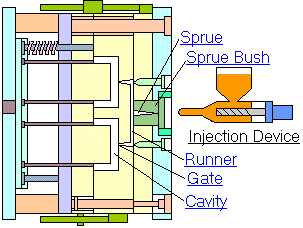
The molten plastics injected from the injector nozzle will go through a sprue (sprue bush), a runner, and a gate and fill up in the cavity. As the temperature of molten plastics is lowered while going through the sprue and runner, the viscosity will rise; therefore, the viscosity is lowered by shear heat generated when going through the gate to fill the cavity.
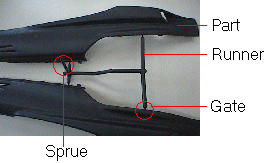
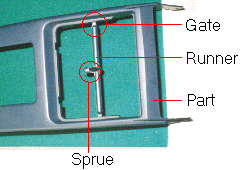
Sprue
A sprue is a channel through which to transfer molten plastics injected from the injector nozzle into the mold. It is a part of sprue bush, which is a separate part from the mold.
Runner
A runner is a channel that guides molten plastics into the cavity of a mold.
Gate
A gate is an entrance through which molten plastics enters the cavity.
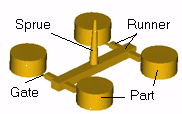
The sprue, the runner, and the gate will be discarded after a part is complete. However, the runner and the gate are important items that affect the quality or the cost of parts..
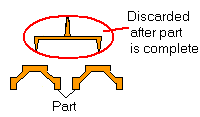
Runner
You need to determine the shapes, dimensions, and positions of the runner taking into consideration the required quality and material of parts, the number of the cavity, so that injection pressure and temperature of molten plastics will not be lowered.
Cross Section of Runner
There are three types of runner cross section – round, trapezoidal, and U-shape.
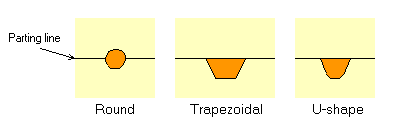
Select a runner cross section that minimizes liquid resistance and temperature reduction when molten plastics flows into the cavity.
In the figure above, a round shape is the ideal. Concerning the mold making process, the round shape requires making half circles to both cavity plate and core plate, which complicates this task.
For this reason, it is considered better to select a runner in a trapezoid cross section which is closer to square, if either the cavity plate or the core plate is shaped.
Size of Runner
The size of runner is determined based on the following factors.
(1) Thickness of Runner
The thickness of runner is determined based on the material or shape of parts. If a runner is too big, cooling solidification will take too much time and molding cycle will be longer. Also, a large runner wastes the molding material , thus raising the cost. On the other hand, too small of a runner would cause molding defects such as short shot or sink mark, adversely affecting the quality of parts.
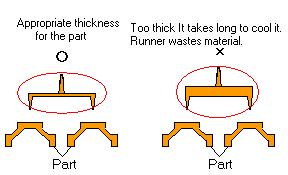
(2) Types of Plastics
As some plastics are superior in flow and the others inferior, determine the shape or the size of a runner according to these factors.
(3) Length of Runner
If a runner is long, enlarge the size of the runner to reduce liquid resistance. However, this will lengthen the cooling time and waste the molding material, causing the cost to rise. It is ideal to shorten a runner as much as possible.
Thin parts of Mold 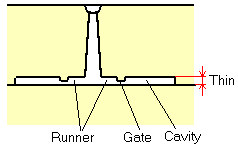 |
Rapidly fills up by accelerating injection speed and raising the mold temperature. Make the runner small so that the flow speed will be accelerated to generate shear heat (the heat generated when molten plastics goes through the gate), which decreases viscosity. |
Thick parts of Mold 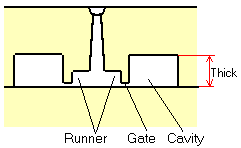 |
Gradually fills up by decelerating injection speed to avoid defective surface of parts such as sink mark or air bubbles by degassing the molding material. Apply the holding pressure and fill up molten plastics in the cavity well. Make a runner larger so that sink marks or short shot will not occur. |
Also be extremely careful in determining the runner size of a three-plate mold.
As the three-plate mold has a certain order for mold opening and tends to have a longer runner, if the mold opening stroke necessary for removal is miscalculated, then removal of parts can not be done.
For the runner of three-plate mold, careful study during the mold design phase is critical.
Layout of Runner
Keep the same distance from a runner to each cavity when molding multiple parts . By doing so, injection pressure will be evenly distributed and molten plastics will fill up evenly in each cavity..
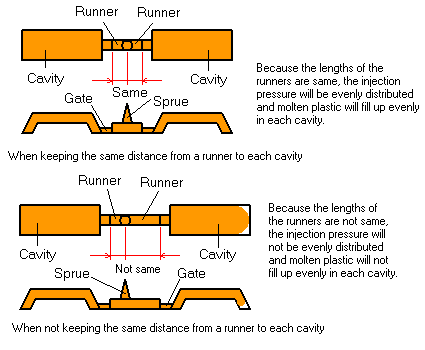

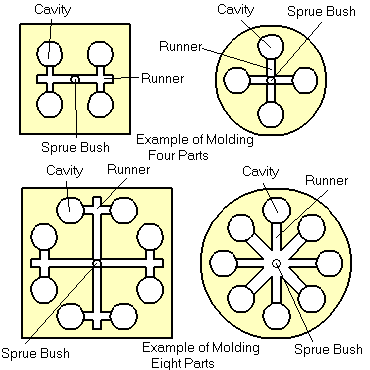
Therefore, the ideal layout for a well balanced runner is a regular polygon (right triangle or a right hexagon) to keep the same distances to all cavities even and distribute injection pressure evenly. The figure below illustrates the example.
Gate
The gate is categorized into restrictive gate, which narrows the entrance, and nonrestrictive gate, which does not narrow the entrance.
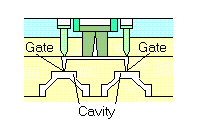
The gate has the following functions:
Restricts the flow and the direction of molten plastics.
Simplifies cutting of a runner and moldings to simplify finishing of parts.
Quickly cools and solidifies to avoid backflow after molten plastics has filled up in the cavity.
Restrictive Gate
A restrictive gate has a narrow entrance to the cavity to restrict the amount of molten plastics in order to improve filling in the cavity. The restrictive gate has the following characteristics.
Generates shear heat by going through the narrow gate, raising the temperature of molten plastics and improving the filling in the cavity.
Reduces residual stress, and thus reduces part defect such as warpage.
As the cooling solidification time is shortened, molding cycle is also shortened.
As the gate trace is less, it is possible to complete finishing process in a short time.
The restrictive gate has the following types.
Side gate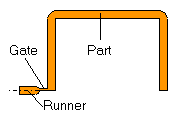 Put to the side of parts. The gate trace will be left. Often used for the structure with more than two cavities. |
Submarine Gate (Tunnel Gate ) 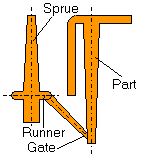 The position is flexible (front, side, or back of parts). The gate needs to be thought about not to be left inside the cavity. |
Pin Point Gate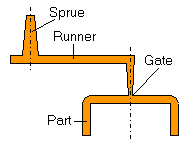 The position is flexible (front, side, or back of parts). The gate needs to be thought about not to be left inside the cavity. |
Fan Gate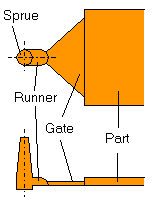 The gate trace will be left. |
Nếu khối ghép tiếp xúc với khuôn mà không có góc vát
Film Gate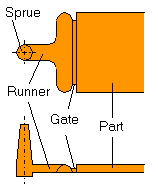 Finishing is difficult and cost is high due to the wide gate. The gate trace will be left. |
Valve Gate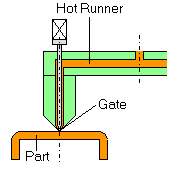 Sprue and runner will not be discharged due to hot runner method. Put to either the front or the back surface of parts. |
Nonrestrictive Gate
A nonrestrictive gate involves a method in which molten plastics fills up in the cavity directly from the sprue. The nonrestrictive gate has the following characteristics.
Reduces the loss of injecting pressure due to direct cavity filling from the sprue.
Less molding material because there is no runner .
The simple mold structure reduces the cost and produces a mold with less trouble.
It is likely that residual stress is generated and parts have crack.
The nonrestrictive gate has the following type.
Direct Gate
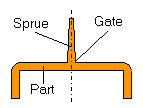 The sprue plays the role as gate. Put on the front or back side of parts. The gate trace will be left.
Determining Gate Potition
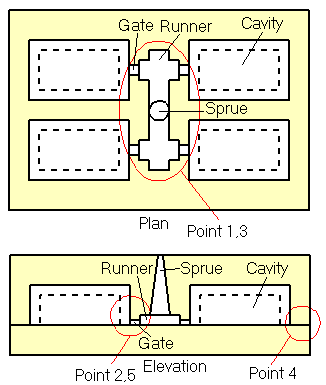
Point 1
Set a gate position where molten plastics finished filling up in each cavity simultaneously. Same as multiple points gate.
Point 2
Basically set a gate position to the thickest area of a part. This can avoid sink marks due to molding (part) shrinkage .
Point 3
Set a gate position to an unremarkable area of part or where finishing process can be easily done.
Point 4
Avoid injecting from the direction where the air in the cavity or the gas generated from molten plastics is inclined to accumulate
Point 5
Fill up molten plastics using the wall surface in order not to generate jetting.
Parts of Sprue
The parts related to a sprue are locating ring and sprue bush
The locating ring functions to position a mold when installing the mold to the molding machine.
The sprue bush is the channel to direct molten plastics inject from the injector of the molding machine into the mold.
Be cautious of the setting for the following items when installing each part.
Locating Ring
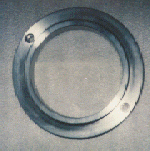
Check the diameter of locating hole of the molding machine. Generally, the diameter of locating ring should be (locating ring diameter) = (locating hole diameter) – (0.1mm to 0.3mm).
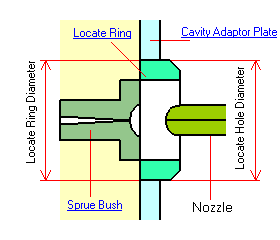
The locate hole diameter is regulated to be 60, 100, 120, and 150, and the thickness of the locating ring is regulated to be 15 mm by JIS.
Sprue Bush
Set the correlation of the nozzle hole diameter and the sprue bush as follows:
|
D1 < D2
D2 = D1 + (0.5 – 1.0)[mm] R1 < R2 R2 = R1 + 1.0[mm] |
D1: Nozzle diamenter D2: Sprue bush hole diameter R1: Nozzle tip R R2: Sprue bush R |
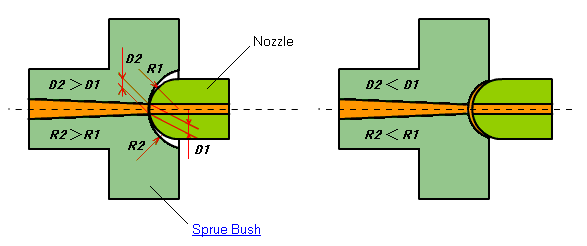
The tip of the nozzle is spherical, and the curvature radius is regulated to be 10 mm, 15 mm, 20 mm, or 30 mm by JIS.
The nozzle diameter is to be selected from Ø2.5, Ø3, Ø4, Ø5. Ø6, Ø8, and Ø10
The high pressured molten plastics injected from the nozzle of the molding machine is injected into the cavity through the sprue bush.
At this point, the center bores of the sprue bush and the nozzle must be aligned so that the high pressured molten plastics will not leak.
A locating ring is attached to the mold to make positioning easier.