


This chapter explains molding defects such as sink mark, warping and whitening and their prevention.
Molding defects are caused by related and complicated reasons as follows:
– Malfunctions of molding machine Inappropriate molding conditions
– Flaws in product and mold design Improper
– Selection of molding material
Such problems are complicated and may not be resolved with only one solution. Therefore, it is difficult to solve the problems in a short period of time. However, it is important to analyze the causes of the molding defects, attempt to find proper solution and eliminate any defects.
Sink Mark

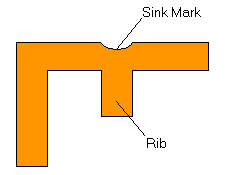
This is the phenomenon where a dent appears on the surface of the product.
It is often observed on crystalline plastics with a high shrinkage rate.
When there is a rib in the back of bumper, a sink mark is created on the surface
Cause
This is caused by shrinkage of the molten plastics during molding.
It is due to inconsistent thickness of molding, which accompanies inconsistent cooling solidification.
This means that pressure is not applied to every part of the mold cavity.
Even though pressure is applied, it diminishes rapidly.
Solution
Raise injection pressure and lower the temperature of molten plastics.
The mold temperature also needs to be lowered.
Make the gate and runner thick and add a gate where sink mark appears. Maintain uniform plastics thickness.
Warpage

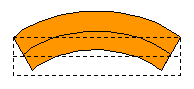
This is the phenomenon where the part is warped or twisted on removal from the mold.
Since molten plastics becomes solidified while flowing, there can be deformation left within the part as residual stress. This deformation appears when the part is removed from the mold and pressure is released.
Cause
Shrinkage timing was missed due to the mold temperature difference (surface temperature difference at cavity and core) .
The volume of Shrinkage changed because of the thickness difference in the part.
Mold temperature was either too high or inconsistent, or cooling was inconsistent.
Molten plastics temperature was high. Injection pressure was low.
Solution
Take a longer cooling time and lower the ejection speed.
Adjust the ejector pin position or enlarge the draft angle.
Examine the part thickness or dimension.
Reduce liquid resistance as much as possible to minimize internal deformation
Whitening

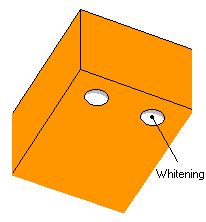
After the ejection by the ejector pin, the surface of the ejected part or surrounding part turns white. When some portion of the part is hard to remove from the mold, that portion also turns white. This phenomenon is called whitening.
Cause
The part was hard to remove from the mold.
Poor quality of the mold surface
Solution
Polish the mold well to facilitate removal of the part.
Lower the injection pressure to facilitate removal of the part.
Reduce the ejector pin speed, and increase the number of ejector pins.
Weldline

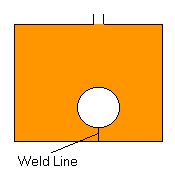
This is a phenomenon where a thin line is created when different flows of molten plastics in a mold cavity meet and remain undissolved.
It is a boundary between flows caused by incomplete dissolution of molten plastics.
It often develops around the far edge of the gate.
Cause
Low temperature of the mold causes incomplete dissolution of the molten plastics.
Solution
Increase injection speed and raise the mold temperature.
Lower the molten plastics temperature and increase the injection pressure
Change the gate position and the flow of molten plastics.
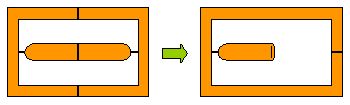
Flashes

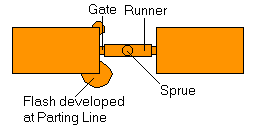
Flashes develop at the mold parting line or ejector pin installation point. It is a phenomenon where molten plastics bulge out and stick to the gap.
Cause
Since the thickness of the part is not uniform, the thick and thin parts have different injection pressures and injection speeds.
Poor quality of the mold.
The molten plastics has low viscosity and high flow.
Injection pressure is too high, or clamping force is too weak.
Solution
Avoiding excessive difference in thickness is most effective.
Slow down the injection speed.
Apply well-balanced pressure to the mold to get consistent clamping force, or increase the clamping force Enhance the quality of the parting lines, ejector pins and holes.
Short Shot

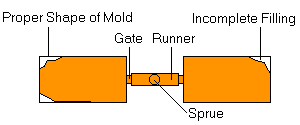
This is the phenomenon where molten plastics does not fill the mold cavity completely. and the portion of parts becomes incomplete shape.
Cause
The injection volume or injection pressure is insufficient.
Injection speed is so fast that the molten plastics become solid before air within cavity is ejected.
Injection speed is so slow that the molten plastics becomes solid before it flows to the end of the mold.
Solution
Apply higher injection pressure.
Install air vent or degassing device.
Change the shape of the mold or gate position for better flow of the plastics.
Jetting

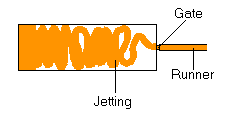
This is the phenomenon where the part has a wire-shape flow pattern on the surface.
Cause
Due to inappropriate gate position, a flow of molten plastics into the cavity is cooled in a line shape and remains undissolved with other plastics flow coming later.
Solution
Raise the molten plastics and mold temperature, and increase injection speed to make the initial and later flows of molten plastics dissolve completely. Change the gate position to make the molten plastics touch the facing side before making a line shape.
Flow mark

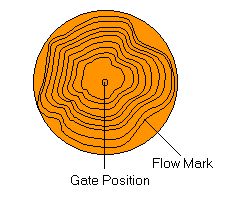
This is a phenomenon where the initial flow of molten plastics which solidifies mixes with a later flow and remains undissolved. It develops distinctive patterns such as clouds, scales or tree rings.
Cause
Injection speed is too fast.
Mold or molten plastics temperature is too low.
Solution
Enlarge the gate area to decrease the speed of the molten plastics flowing through the gate. Increase the pressure retention time for better pressure quality.