


You will learn about the effect of mold cooling, position of cooling channel, and cooling method for each part.
The temperature of a mold has a great impact on molding.
For example, if the temperature of the mold is too low, molten plastics will not flow smoothly through the runner or the gate, thus may not fill up in the cavity.
On the other hand, if the temperature is too high, it will take too long to cool down and solidify the molten plastics, so the molding cycle will be longer.
Therefore, by controlling the temperature of the mold, the following effects can be expected:
– Molding cycle can be shortened by reducing time for cooling and solidification of molten plastics.
– The surface quality or measurement accuracy of parts can be improved by better mold ability.
– Warpage or stress in a part can be avoided that is caused when mold shrinkage varies due to different thickness, leading internal stress difference.
Effective mold cooling is done by pouring cold water into the mold through a cooling channel.
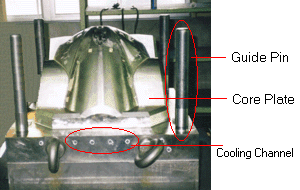
Let’s see the detailed explanations of a cooling channel.
Position of Cooling Channel
To effectively cool down a mold, decide on a position of the cooling channel considering the following remarks.
- Adjust the mold temperature by pouring a large amount of water having a temperature close to the temperature required for molding.
- Increase the number of the cooling channels rather than enlarge the diameter of one cooling channel.
- Make sure to cool a cores (insert) which are difficult to cool, such as a thick core, a large size slide core, or a loose core.
- Use mold material that has high heat conductivity to improve effectiveness of cold water.
Cavity Cooling
Position a cooling channel as shown in the figure below for cavity cooling.
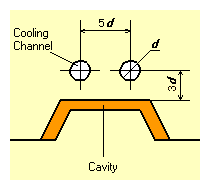
Since the numbers shown are for a general case, it is necessary to consider the position of a cooling channel according to molding material, molding shape, or mold material type.
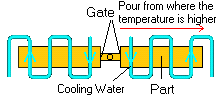
Also, the cold water should flow from where the temperature of molten plastics is higher (closer to the gate) in the same direction as the molten plastics flows.
Example of 2 dimensional cooling channel
Pour cold water over the top side of parts.
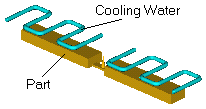
Example of 3 dimensional cooling channel
Pour cold water to wrap parts.
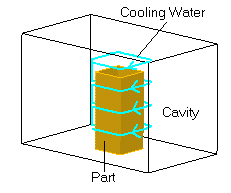
Core (Insert) Cooling
The cooling methods of core (insert) are listed below:
If the core is too small for a cooling channel to go through: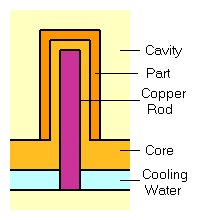 |
If the core is large enough to go through a cooling channel.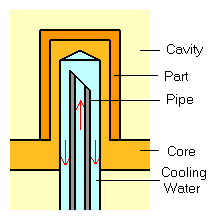 |
Cools down by baffle method in which a dividing plate is attached in the cooling channel on the core and cold water is poured to cross over the plate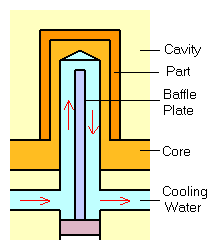 Make a core of beryllium copper and cool it down. |
If there is a large cooling channel in a core: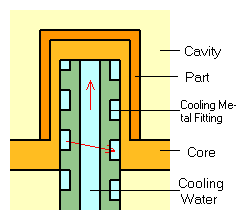 |