


This appendix explains the major types of molds and their movements for screws. Screw thread molding is the same as the undercut process. There are various molding methods depending on the shapes of a screw or the type of screw (inner and outer screws), and each method will be explained here using animated graphics.
Types of Screw
Screws are divided into inner screws (female screws) and outer screws (male screws).
When molding a screw, if the screw part is molded completely, the part or the edge of the screw may be damaged when removed from the mold or the molding process will be extremely difficult; therefore, it is necessary to stop in advance as shown below.
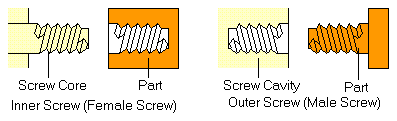
Molding Inner Screw
Sau đây là một số cách để đúc như khi sản phẩm có ren trong, việc chọn cách này tùy theo hình dạng và kiểu ren.
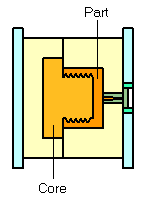
Fixed Screw Core Molding
The followings are the methods for inner screw molding . The method to be used is determined by the shape of part or screw.

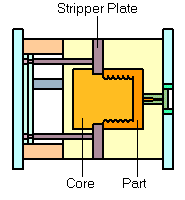
Force Ejection Molding
Parts are forcibly ejected by a stripper plate. It is used when the shape of a screw is round and the parts are made of molding materials such as nylon, polyethylene, or polypropylene.
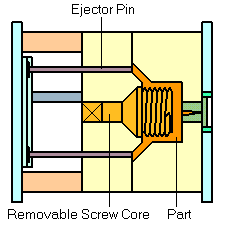
Removable Screw Core Molding
A part and a removable screw core are removed together first, and then the part is removed. Make several removable screw cores, remove the removable screw core with a part, and attach another core to the mold to efficiently remove parts while molding another screw.
Rotating Screw Core Molding (1)
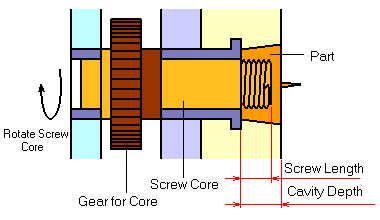
A screw core is rotated at the position to remove a part. Part requires anti-rotation process (e.g. making the outer shape polygonal or uneven) in this method.
Also, anti-rotation process is required to an ejector or a part unless the length of the screw area of the screw core is a little shorter than the depth of the cavity of the mold.
Rotating Screw Core Molding (2)
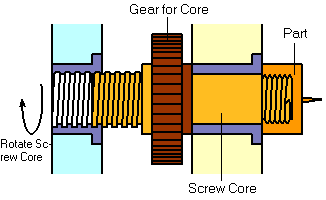
Parts are removed by moving a screw core backward while rotating. Make the screw pitches the reverse of the screw core and the screw pitch of the part same, or the screw will be damaged.
Positioning of Rotating Screw Core
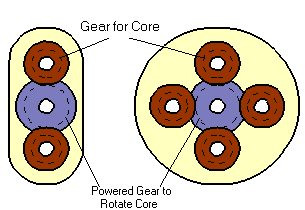
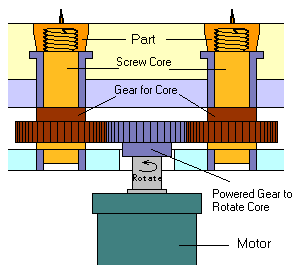
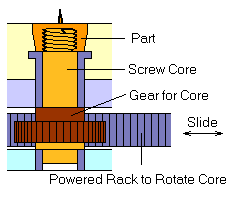
Since power is needed to rotate a screw core for the rotating screw core molding, core positioning requires consideration. There are circular positioning and straight positioning for core positioning.
Circular Positioning
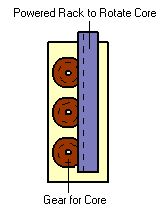
A gear to rotate a core positioned in a circle is positioned at the center of the circle.
Straight Positioning
A core is positioned on a straight line to make a rack touch the core.
Molding Outer Screw
The following are the methods for other screw molding . Like inner screw molding methods, the method to be used is determined by the shape of the part or screw.
Fixed Screw Cavity Molding
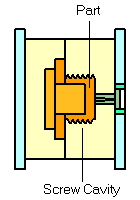
Like fixed screw core molding for inner screw, the cavity is directly shaped as a screw and parts are removed manually. It is necessary to make a hexagonal hole on the edge of parts in order to remove them.
Force Ejection Molding
Like the force ejection molding for inner screw, parts are ejected forcibly by an ejector pin.
This method is only used when the material of parts have elasticity and the screw is round.
Slide Core Screw Molding
The method uses a slide core which slides to remove parts after molding. An angular cam is used for the slide core to slide so that the slide core will move after a mold has completely opened.
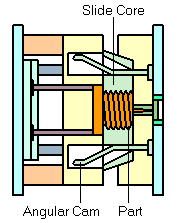
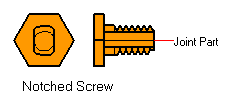
It is very difficult to mold accurately with this method, which may create a flash at the joint of the slide core. Thus, make a notch on the screw, as shown in the figure below, and make a joint here to obtain accuracy at the joint part to reduce defects.
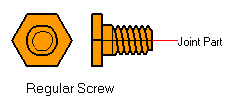
If a flash occurs at the joint, the screw will not be molded properly.
Even if a flash occurs at the joint, the screw will be molded properly.